-01.png)
Social Entrepreneurship and Theory of Change: What SMU Global Summer Programme Students Learned at Make The Change
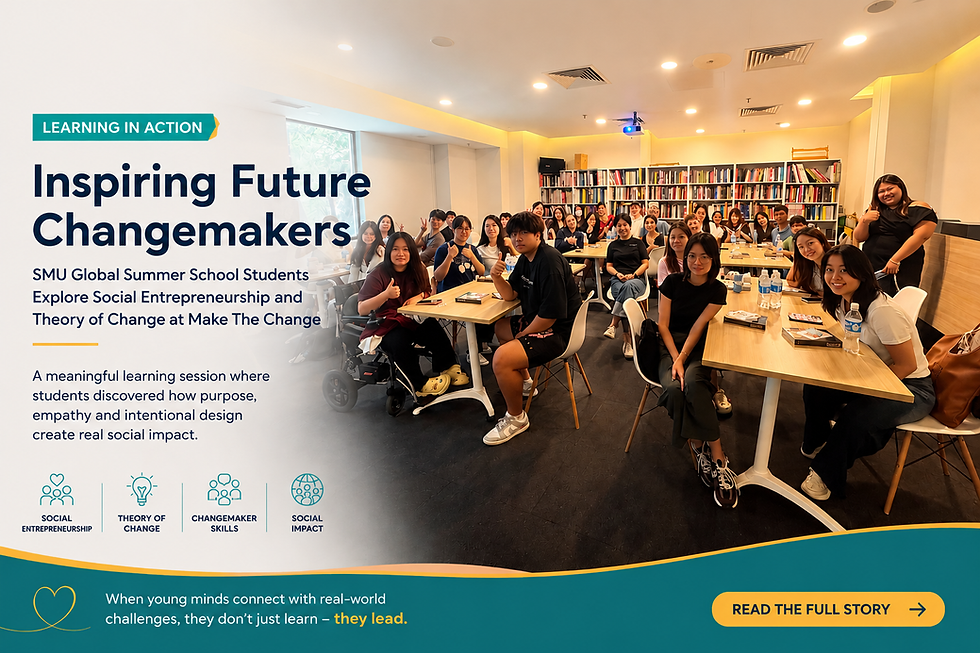
How do you move from caring about a social issue to actually creating meaningful change?
That was the question at the heart of a recent learning session hosted by Make The Change for students from the SMU Global Summer School programme. During their visit, students heard from Make The Change CEO Michelle Lim and Community Development & Impact Director Pedro Aguirre about what it means to build a purpose-driven organisation, how social entrepreneurship works in practice, and why Theory of Change matters when designing programmes, initiatives, and solutions for real-world problems.
The session gave students a practical introduction to social entrepreneurship, impact design, and changemaking frameworks that can help turn good intentions into meaningful action.
Learning about social entrepreneurship in Singapore
At Make The Change, we often talk about social entrepreneurship not just as starting a business with a mission, but as a way of thinking and working.
Social entrepreneurship is about identifying a real problem, understanding the people affected by it, and building solutions that create positive social impact. It requires more than creativity or passion alone. It also requires empathy, systems thinking, reflection, and a clear understanding of the outcomes you are trying to create.
During the session, Michelle and Pedro introduced students to Make The Change as a Singapore-based social enterprise working across education, youth development, digital inclusion, community impact, and purpose-driven innovation. Students learned how our work spans workshops, learning journeys, youth programmes, digital skills initiatives, and creative projects designed to equip people with the tools to contribute to society in meaningful ways.
For students exploring the role of business, innovation, and leadership in society, the session offered a real-world example of how a social enterprise can combine purpose with practical action.
Why Theory of Change matters in social impact work
A key focus of the session was Theory of Change.
Theory of Change is a framework that helps organisations, educators, and changemakers think clearly about how change happens. Instead of only asking, “What activity should we run?” it asks a more important set of questions:
What problem are we trying to solve?
Who are we trying to support?
What change do we hope to create?
What needs to happen for that change to become possible?
How will we know whether our work is making a difference?
At Make The Change, Theory of Change is an important part of how we design and evaluate our work. It helps us stay focused on the real problem, not just run activities for the sake of it. It supports us in designing programmes with purpose, connecting learning to real-world outcomes, and making decisions about what to prioritise. It also helps us measure impact in ways that go beyond attendance numbers or satisfaction scores alone.
This matters because in social impact education and community development, not everything important can be reduced to a single metric. Some of the most meaningful outcomes show up through stories, observations, learner reflections, behaviour shifts, confidence, participation, and examples of action over time.
From workshops to meaningful outcomes
One of the ideas we explored with the SMU students was that two activities can look very similar on the surface, but lead to very different outcomes depending on how intentionally they are designed.
A workshop can be engaging and enjoyable, but if it is not connected to a clear purpose, it may not lead to deeper learning or meaningful impact. A Theory of Change helps turn an activity into an intentional pathway for change.
For example, a programme about sustainability, inclusion, digital wellbeing, or youth leadership should not only ask whether students enjoyed it. It should also consider what they understood more deeply, what skills they developed, what mindsets shifted, and what action they are now more prepared to take.
This is one of the reasons Make The Change integrates changemaker skills, reflection, and real-world relevance into our programmes. We want learning experiences to be memorable, but also meaningful.
A hands-on Theory of Change activity for students
To help students apply the ideas from the session, they participated in a group activity in which they were challenged to build their own mini Theory of Change.
Working in small groups, students selected a cause and began mapping out a possible pathway for change. The themes included:
Student mental wellbeing
Inclusion on campus
Sustainability on campus
Digital wellbeing
Career readiness for vulnerable youth
This activity pushed students to think beyond broad statements like “we want to help” or “this issue matters.” Instead, they had to consider the underlying problem, the people affected, the outcomes they hoped to achieve, and the actions that could move that change forward.
In doing so, they practised several important future-ready and changemaker skills: empathy, critical thinking, collaboration, systems thinking, communication, and problem framing.
Building changemakers through social entrepreneurship education
At Make The Change, we believe many young people want to make a difference, but they often need the right environment, tools, and support to turn that motivation into action.
That is why we care deeply about creating learning experiences that go beyond awareness. We want participants to leave with clearer thinking, stronger skills, and a better understanding of how change can actually happen.
For the SMU Global Summer School students, this session was not only about understanding Make The Change as an organisation. It was also an invitation to think more deeply about their own role in creating change, whether in business, education, policy, community work, or entrepreneurship.
When students understand both social entrepreneurship and Theory of Change, they are better equipped to move from ideas to action, and from action to impact.
Why universities and schools are exploring Theory of Change and changemaking
Across schools, universities, and youth programmes, there is growing interest in helping students become more thoughtful problem-solvers and more socially conscious leaders.
Frameworks like Theory of Change are useful because they help learners connect classroom ideas to community realities. They encourage students to ask better questions, think in systems, and understand that impact is not only about doing something, but about understanding what that action is meant to change.
For institutions looking to develop students’ leadership, social innovation, and civic engagement skills, this kind of learning can be a powerful complement to academic study.
Thank you to SMU Global Summer School
We are grateful to the students and organisers from the SMU Global Summer School programme for visiting Make The Change and spending time with our team. It was a pleasure to share our work, our thinking, and our approach to social entrepreneurship and impact design.
We hope the session gave students useful tools for thinking more intentionally about social change, and that it sparked new ideas about how they can contribute in their own communities and future careers.
Looking for a social entrepreneurship workshop or learning journey in Singapore?
Make The Change runs workshops, talks, learning journeys, and educational programmes on topics such as:
Social entrepreneurship
Theory of Change and Impact Design
Changemaker skills and youth leadership
Sustainability and community impact
Digital storytelling and advocacy
Future-ready skills and social innovation
If your school, university, or organisation is looking for a social entrepreneurship workshop in Singapore, a Theory of Change learning session, or a student changemaker programme, we’d love to explore how we can support you.
Get in touch with Make The Change to design a learning experience that helps students connect ideas, action, and impact.

